
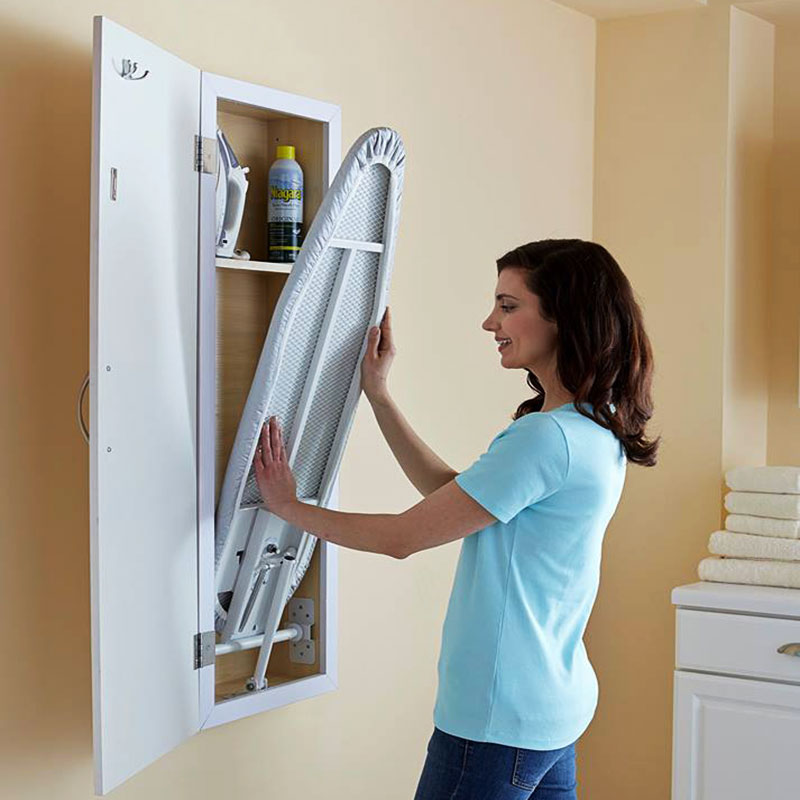
Choose a wall-mounted board when floor space is the binding constraint and the wall can take a structural fixing. Choose freestanding when you need height adjustment across roughly 28-38 in (71-97 cm), a full 15 x 54 in (38 x 137 cm) surface, or you rent and cannot drill. Wall units win on space; freestanding wins on flexibility.
Key facts
- A freestanding frame typically adjusts across roughly 28-38 in (71-97 cm); a wall bracket is fixed at the height you install it.
- Comfortable standing height is about 32-36 in (81-91 cm) for most adults, so measure the main user first.
- Full-size surfaces measure about 15 x 54 in (38 x 137 cm); wall formats commonly measure 12-13 x 36-44 in (30-33 x 91-112 cm).
- A folded wall unit takes no floor area; a freestanding board needs a parking place.
- Trade note: US antidumping order A-570-888 covers floor-standing tables; legless wall boards sit outside that scope. Confirm with a licensed customs broker.
The eight criteria that decide it
One constraint usually binds hardest. Find it, then read across.
| Criterion | Wall-mounted | Freestanding | Usually wins |
|---|---|---|---|
| Floor area in use | Board only, no legs underfoot | Board plus legs you walk around | Wall-mounted |
| Space when stowed | Flat to the wall, no footprint | Needs a closet or corner | Wall-mounted |
| Stability | As good as the anchor behind it | Four legs, rocks on uneven floors | Depends on the wall |
| Height adjustment | Fixed at install | Typically 28-38 in (71-97 cm) | Freestanding |
| Board size offered | Commonly 12-13 x 36-44 in (30-33 x 91-112 cm) | Up to 15 x 54 in (38 x 137 cm) | Freestanding |
| Setup to first press | Unlatch and lower | Carry, open, level the legs | Wall-mounted |
| Reversibility | Leaves fixing holes to patch | Leaves nothing behind | Freestanding |
| Moving house | Unscrew, patch, re-drill next time | Goes in the van as it is | Freestanding |
Floor space and the board size each format can give you
Floor space is the reason most households switch. A folded wall unit sits in the depth of its own bracket, which is why it works in a laundry closet barely deeper than the machines, or in a guest room where a stored board would be visible.
Size is the cost of that. Wall formats are commonly built at 12-13 in x 36-44 in (30-33 x 91-112 cm), because a longer cantilever puts more leverage on the fixings. Freestanding boards carry their length on legs, so full-size 15 x 54 in (38 x 137 cm) surfaces are ordinary. If duvet covers are a weekly job, that gap matters more than the closet you free up.
Stability and height: the two trade-offs you feel daily
Stability works differently in each format rather than being better in one. A freestanding board resists movement through four contact points, so it rocks when a floor is uneven or a leg catch is worn. A wall unit has no legs to splay, and movement almost always traces back to the fixing: a hollow-wall anchor where the load needed a stud or a plywood backer.
Height is the clearer trade. A freestanding board follows whoever is using it across roughly 28-38 in (71-97 cm). A bracket is set once, so a household with a wide height gap either splits the difference or specifies an adjustable bracket. Measure the primary user first, following the method in our wall-mounted ironing board height guide.
Installation, permanence and what happens when you move
A freestanding board has no install cost and no permanence, which makes it the only sensible answer for a short lease or a wall you cannot touch.
A wall unit is a small building job: locating solid backing, drilling, and using fixings sized for a cantilever load. Done properly it lasts for years and never gets in the way; done into bare plasterboard it will loosen. Moving house means removing the bracket, making good the holes and repeating the job at the next address, so the more settled the home, the better the format looks. Renovators who want the board hidden entirely should compare built-in ironing boards.
A scope note for importers and trade buyers
Format affects US customs treatment, not just ergonomics. The antidumping order on Floor-Standing, Metal-Top Ironing Tables and Certain Parts Thereof from the People’s Republic of China (A-570-888) was published on 6 August 2004 at 69 FR 47868, commonly entered under HTSUS 9403.20.0011, and continued after the 2010, 2016 and 2021 five-year reviews. A fourth review was instituted on 1 July 2026.
The scope reaches floor-standing goods. Boards without legs, including wall-mounted and over-door models, are not floor-standing and sit outside it, as do tabletop models whose legs do not exceed 12 in (30 cm). The PRC-wide rate is commonly cited at 157.68%. None of this is legal advice: confirm your classification, the current rate and the review status with a licensed customs broker or with CBP before ordering.
Choose wall-mounted if, choose freestanding if
Choose wall-mounted if the room has no storage gap, the wall has studs or masonry behind it, and one adult does most of the ironing. Choose freestanding if you rent, share the work with someone much taller or shorter, press bed linen weekly, or expect to move soon.
| Reader situation | Best format | What settles it |
|---|---|---|
| Studio or galley laundry with nowhere to store a board | Wall-mounted | No stowed footprint |
| Rented apartment, no drilling allowed | Freestanding | Nothing to make good on exit |
| Two adults with very different heights | Freestanding | Adjustment across 28-38 in (71-97 cm) |
| Weekly bed linen and curtains | Freestanding | Full 15 x 54 in (38 x 137 cm) surface |
| Compact hotel or serviced guest room | Wall-mounted | 13 x 32-34 in (33 x 81-86 cm) boards are commonly specified |
Frequently asked questions
Can a wall-mounted board carry as much weight as a freestanding one?
Most manufacturers publish no load rating for either format, so compare the load path instead of guessing. A freestanding board spreads weight over four legs onto the floor, while a wall unit sends everything into two or four fixings. Ask the supplier for the recommended fixing type and the wall construction it assumes.
Which format suits a laundry closet best?
A wall-mounted board, in most cases, because a closet rarely has the depth to store a full-size board and still close its doors. Mount the bracket on the side wall so the board swings clear of the machines, and check the door swing before drilling. A compact 36-44 in (91-112 cm) board fits where a 54 in one will not.
Do hotels use wall-mounted or freestanding boards?
Both are common, and the split follows room size. Compact rooms tend to get a fixed board so nothing has to be stored, while suites and long-stay units often keep a full-size board in the wardrobe. Boards of about 13 in x 32-34 in (33 x 81-86 cm) are commonly specified for guest rooms. Confirm against the property’s own FF&E specification.
Can you get a full-size 54 in board that mounts on a wall?
Rarely in the surface-bracket format, because board length multiplies leverage on the fixings. Longer boards of 42-46 in (107-117 cm) are more common inside built-in cabinets, where the carcass carries the load instead of two screws. Where a full-size surface is essential, freestanding remains the answer.
About Venace
Venace Intelligent Technology Inc. focuses on built-in, wall-mounted, fold-down and folding pull-out ironing boards for distributors, cabinet manufacturers, contractors, hospitality projects and OEM/ODM buyers. Review the VENACE ironing board range or contact the team with your product type, installation space, target quantity and destination market.
Sources
- Federal Register – fourth five-year review of the antidumping order on ironing tables from China, with the order’s scope and history.
Additional buyer questions
How should buyers evaluate Wall mounted vs freestanding ironing board — which is better?
Use the exact model drawing and inspect the installation surface. Confirm fixing points, stored dimensions, full opening path, nearby obstructions, and access for installation and service before work begins.
How should buyers evaluate wall mounted ironing board vs freestanding?
Use the exact model drawing and inspect the installation surface. Confirm fixing points, stored dimensions, full opening path, nearby obstructions, and access for installation and service before work begins.
How should buyers evaluate wall mounted vs freestanding ironing board which is better?
Use the exact model drawing and inspect the installation surface. Confirm fixing points, stored dimensions, full opening path, nearby obstructions, and access for installation and service before work begins.
How should buyers evaluate wall mounted ironing board vs freestanding which is better?
Use the exact model drawing and inspect the installation surface. Confirm fixing points, stored dimensions, full opening path, nearby obstructions, and access for installation and service before work begins.
Pozdrav
Interesira mi cijena ugradbene daske za peglanje koja se montira u ormar po visini cijela