B2B PLANNING GUIDE
Commercial Ironing Board Covers: How to Review Heat and Fabric Claims
Select a commercial ironing board cover by its fit, documented construction, care instructions and evidence relevant to the project. Terms such as heat resistant or fire retardant need a defined scope; they do not establish an unlimited protective property. Request information for the actual supplied cover and assembly before using a safety claim in a specification or catalogue.
Describe the cover you are buying
A cover is more than a fabric name. Record the surface material, any stated coating, padding arrangement, attachment method and the board shape it is designed to fit. Ask which of those elements are included in the supplied product and which are ordered separately as replacements.
A buyer comparing two covers should identify those details before drawing conclusions from appearance. Similar-looking surfaces can be sold with different construction or care information. Conversely, different colours do not by themselves establish different performance. Keep the purchasing description specific enough that the supplied replacement can be checked against it.
Separate a description from a substantiated claim
A marketing label can identify the type of question to ask, but it is not the answer to that question. If a project requires a particular property, request the relevant evidence and check what the document actually identifies. Avoid replacing a missing explanation with a stronger phrase such as scorch-proof.
Do not assume a named test applies simply because it appears in a keyword list or on another product page. Ask the supplier and the responsible project reviewer to connect the requirement, method and supplied item. If that connection has not been established, describe the available material information without presenting certification as confirmed.
| Information requested | Check in the response | Reason to keep it in the record |
|---|---|---|
| Product identity | Cover code and compatible board | Prevents evidence being assigned to another item |
| Construction | Fabric, coating and padding as supplied | Defines the configuration under review |
| Claim scope | Exact property and stated conditions | Avoids an unlimited interpretation |
| Supporting document | Method, sample identity and reported result | Shows what evidence is actually available |
| Care instructions | Cleaning and replacement guidance | Supports the property’s operating process |
| Revision history | Changes to material or assembly | Identifies when a review needs updating |
The purpose of this table is traceability. It does not prescribe a universal fabric standard or a required test result. Those requirements must come from the actual project and the applicable review process, with documentation for the product being supplied.
Read the scope before promoting the result
When a report is available, identify the sample and configuration it describes. Ask whether it concerns the outer fabric alone, a layered cover or another assembly. Keep any stated preparation and conditions with the reported result rather than copying a short passing phrase into sales copy without context.
A document can be useful while still leaving an important question unanswered. For example, the named material may be identifiable but the relationship to the current replacement cover may need confirmation. Record that question clearly. Do not infer that every colour, supplier batch or revised construction has been covered by evidence for a different version.
Check fit on the intended board
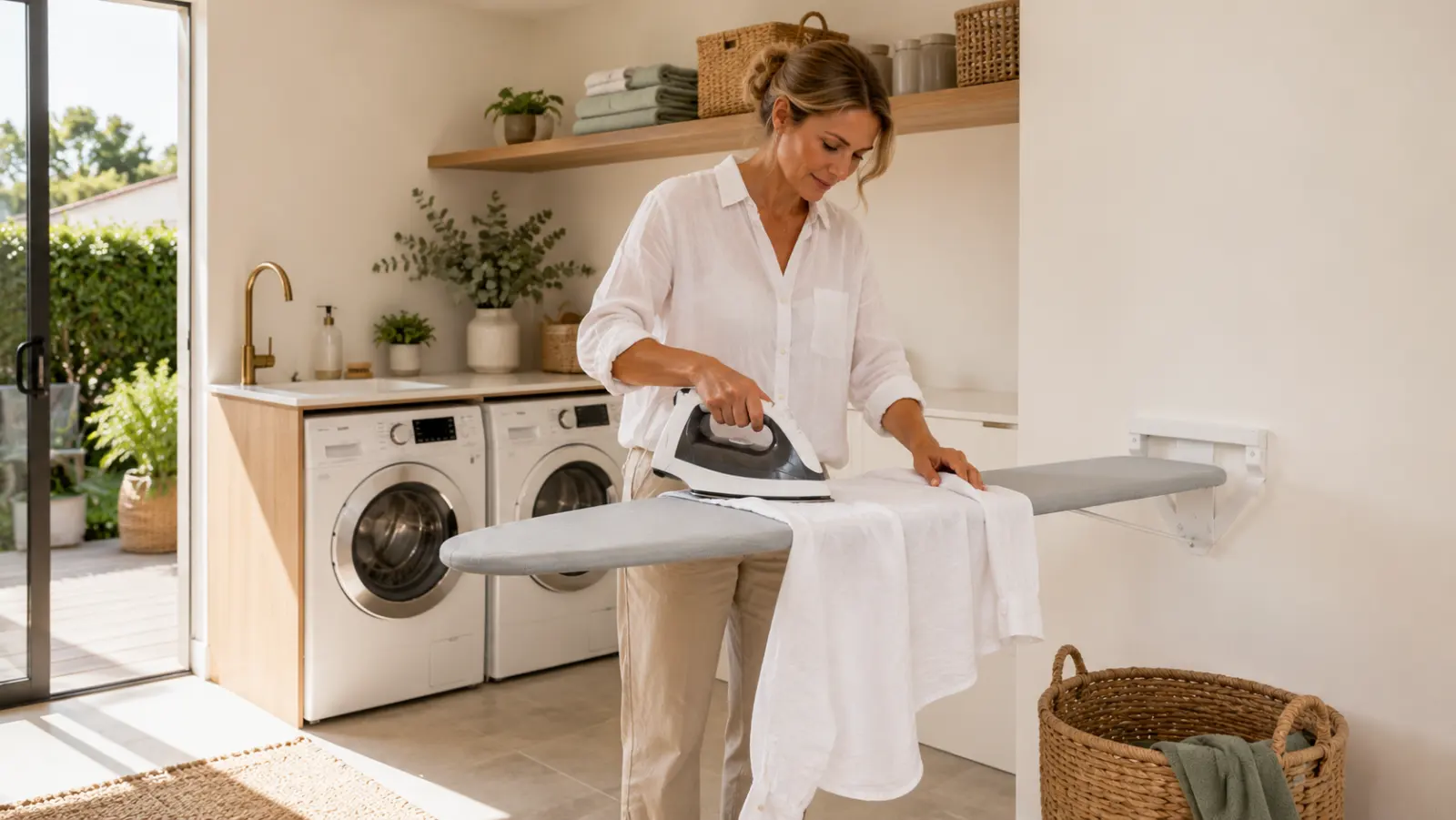
Use a representative cover on the selected board shape. Review edge coverage, the attachment arrangement and how the cover remains positioned through the normal folding sequence described by the product instructions. A suitable material description cannot resolve a cover that does not fit the actual surface.
For a fold-down model or built-in board, confirm that the cover arrangement is compatible with storage and deployment. Ask whether any supplied padding must stay with the cover and how replacement is performed. Keep the approved replacement identification in the order record rather than relying on an approximate board length alone.
Review the whole working-surface arrangement
The source product specification may identify a perforated or mesh deck intended to allow steam to dissipate. Assess that deck together with its supplied padding and cover rather than assigning all working-surface behavior to the outer fabric. Request information that describes the complete arrangement being evaluated.
This is also why a material comparison should not declare a universal winner without matched evidence. A buyer can compare construction and documentation, then review representative samples under an agreed, appropriate process. The deck comparison guide provides a separate checklist for the supporting surface.
Make care information usable for operations
Ask for the supplied care instructions in the language used by the operating team. The instructions should identify the cover or product they concern and explain the stated cleaning and replacement approach. If a hotel’s existing process appears incompatible with that guidance, resolve the issue before ordering rather than assuming a different treatment is acceptable.
Include cover inspection in the property’s own documented maintenance process. Record who identifies an item needing attention and how the correct replacement is requested. This operational decision can be made without inventing a fixed service interval or claiming that a cover lasts a universal number of uses.
Control replacement orders and substitutions
A replacement purchase should specify the compatible board model, cover code and approved construction. If the supplier proposes a changed material or attachment, ask what has changed and whether the original fit and documentation still apply. Treat an unexplained substitute as a review item rather than a routine colour variation.
For private-label orders, ensure that packaging and care wording describe the supplied product accurately. Any translated claim should retain the same scope as the reviewed original. A stronger phrase introduced during translation can create a promise that the source document never made.
Cover procurement checklist
- Board compatibility and cover identification are recorded.
- Fabric, coating, padding and attachment are described.
- Any requested property is tied to a defined project requirement.
- Available evidence identifies the relevant sample and scope.
- Fit and folding behavior are reviewed on the selected board.
- Care and replacement instructions are available to the operating team.
- Changes and substitutions trigger a documented review.
- Catalogue and label wording stays within the available evidence.
Request a cover review
Send the board model, intended use, quantity, care process and any actual project documentation requirements through the RFQ page. Ask which cover options and supporting information are currently available. If you need a replacement, include photographs and existing identification so compatibility can be checked.
For hotel purchasing, connect this information with the guest-room specification. The useful outcome is a cover that is clearly identified, suitable for the reviewed assembly and supported by accurate instructions. It is not an unsupported promise that a fabric is immune to heat, scorching or every possible operating condition.
Questions buyers ask
Does “heat resistant” mean a cover cannot scorch?
No such unlimited conclusion should be drawn from that phrase. Request the exact claim, stated conditions and relevant product information, and avoid replacing a limited description with a scorch-proof promise.
What should I check when a supplier sends a fabric report?
Check the sample identity, construction, method, conditions and reported result. Confirm how that sample relates to the current cover and assembly you intend to purchase.
Can I order replacements using board length alone?
Use the board model and compatible cover identification where available. Shape, attachment and padding arrangement also need to match the reviewed product, so an approximate length is insufficient.
Should translated labels use stronger safety wording?
No. Keep the translated claim within the scope of the reviewed original and supporting information. A translation should not introduce certification or unlimited protection that has not been established.
Explore the product range
Discuss your project
Send drawings, application and quantity for a project review.