
B2B PLANNING GUIDE
Drawer Slides and Folding Mechanisms for Pull-Out Ironing Boards
Damping, travel stops and locking describe different jobs in a folding mechanism. Motion control does not by itself establish that a board is securely retained in its working position. Ask how the exact model opens, stops and stays in place, and confirm whether any requested hydraulic or soft-close feature is actually available before specifying it.
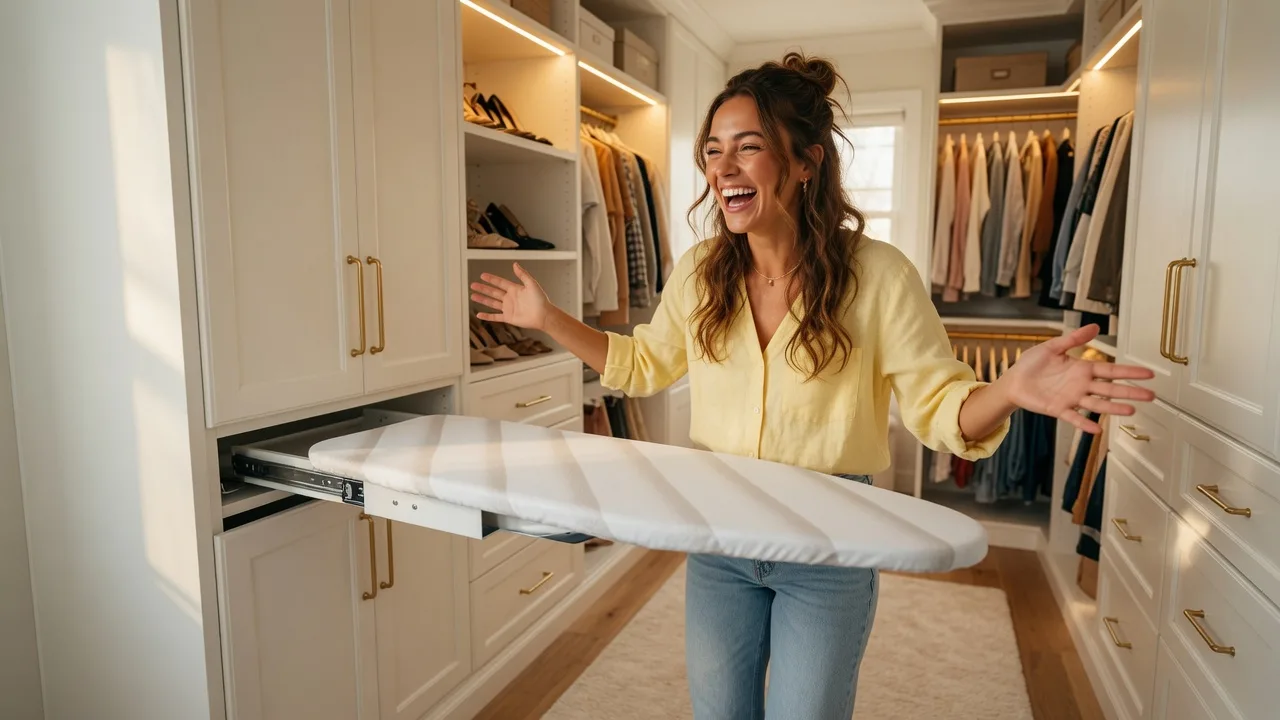
Separate the functions before choosing terminology
A product description can combine words such as smooth, soft-close and stable without explaining the mechanism. Start by asking what each component is intended to do. One question concerns how movement is controlled; another concerns the limit of travel; another concerns how the working position is retained.
Keeping these questions separate prevents a buyer from accepting an attractive closing demonstration as proof of every function. The names alone do not show how a particular board behaves, what adjustments it needs or whether the arrangement is suitable for the planned installation. Request the model instructions and an explanation of its operation.
| Function under review | Question for the supplier | Evidence to request |
|---|---|---|
| Motion control or damping | What controls movement during opening or closing? | Model description and demonstration |
| Travel limit or stop | What defines the intended end position? | Drawing and operating sequence |
| Working-position retention | How does the board remain in its intended position? | Instructions for the relevant retaining feature |
| Release or adjustment | What must the user operate to move it again? | Clear illustrated steps |
| Storage retention | How is the board kept in the stored arrangement? | Model-specific explanation |
| Service adjustment | Which adjustments remain accessible after fitting? | Maintenance and installation information |
A single assembly may combine functions, but the buyer still needs each question answered. Do not infer the internal arrangement from a photograph or apply a description from a different product to the model being ordered.
Confirm the feature is part of the offered model
If a project asks for hydraulic damping or soft-close movement, put that request in the enquiry as a requirement to review. Ask whether an available model provides it, whether an alternative arrangement is proposed and what documentation supports the description. This article does not establish that VENACE supplies either feature on a particular ironing board.
Keep the supplier’s response attached to the exact model and configuration. A feature discussed during development should not appear as a standard catalogue capability until the supplied product and its scope are confirmed. The same applies when a distributor prepares a translated product listing from an early commercial conversation.
Review working-position retention directly
Observe how the selected board reaches the intended working position and what the instructions require before use. Identify the relevant adjustment or retaining action. Ask whether the user receives a clear indication that the required step is complete, without assuming that any audible click or resistance has a particular meaning.
For a swivel arrangement, review both deployment and the selected orientation. VENACE’s supplied wall-mounted guide describes its own adjustment and tightening sequence; use those model-specific instructions for that product. Do not turn them into a universal rule for all boards with a pivot or a folding bracket.
The swivel clearance guide covers the surrounding movement envelope. Adequate clearance and correct retention are separate review items. A board can have room to turn while still requiring the user to complete a specified adjustment before the intended operation.
Ask what happens throughout the movement
A demonstration should show the full sequence: storage, opening, any intermediate adjustment, the working position and return to storage. Ask the presenter to identify required user actions rather than moving the product quickly through them. A short final-position video can hide steps that matter to the customer.
Keep the demonstration within the product instructions. Its purpose is to understand normal operation, not to prove that the mechanism eliminates every pinch, impact or misuse scenario. Do not publish an injury-prevention guarantee simply because closing looks controlled in one recording.
For a fold-down board, review the folding and deployed positions. For a pull-out board, review the travel and any unfolding stages. Product names help organize the questions, but the exact mechanism determines the answer.
Include the installation in a smooth-operation review
The operating behavior should be checked in the reviewed mounting arrangement. The supporting wall or cabinet, fixing interfaces and nearby furniture are part of the installed system. If a sample demonstration uses a different arrangement, identify the difference before treating it as the final project approval.
Record observations without guessing their cause. For example, contact with adjacent furniture, resistance during travel and movement at the mounting interface are different observations. A request for a stronger damper may not address a clearance conflict or an installation discrepancy, so first establish what is actually happening.
Distinguish adjustment from unapproved modification
Ask which adjustments are described in the instructions and how they remain accessible after installation. A concealed position can make a control or service point harder to reach once furniture is complete. Resolve that access during the sample review rather than assuming it can be addressed later.
Do not add a generic damper, change a support component or substitute a retaining feature without review of the complete arrangement. If the desired operation differs from the available model, treat it as a proposed development requirement. An OEM/ODM discussion should identify the change, feasibility questions and evidence needed before approval.
Write a functional sample record
- Identify the model, revision and installation arrangement.
- Describe each required user action in the operating sequence.
- Identify how travel ends and the working position is retained.
- Confirm whether requested motion-control features are actually supplied.
- Record clearance and access observations separately from mechanism observations.
- Keep the supplier’s adjustment and care information with the sample record.
- Resolve any proposed modification before treating the sample as approved.
Repeat the affected review if the mechanism, mounting arrangement or nearby furniture changes. The record should make clear which configuration was observed, rather than preserve only a general comment that the sample operated smoothly.
Prepare a mechanism enquiry
Send the intended product format, installation drawing, quantity and desired operating sequence through the RFQ page. Explain the practical concern behind a feature request, such as a preferred return-to-storage action or accessible adjustment. Ask for available models and their actual operating information.
Use the load-evidence guide for supporting test questions and the sourcing checklist for approval records. Separating motion control, stops and retention helps buyers request a defined behavior while keeping product claims tied to what is actually supplied.
Select drawer slides as part of the complete assembly
For a pull-out ironing board, begin with the travel required to bring the mechanism through the cabinet opening into its intended operating position. Ask the supplier for the installed runner length, extension travel and position of the carriage at each stage. Do not assume that every installation requires a slide sold as full-extension, or that this label by itself establishes compatibility with the folding board.
Compare the installed runner envelope with the clear cabinet dimensions, including fixing heads, side clearance and the rear service space. The relevant dimensions are those of the supplied system and its approved mounting arrangement. A runner that fits the empty cabinet can still leave the folded board, drawer front or release control obstructed. Check the opening sequence in a representative cabinet before approving the furniture design.
A slide component rating is not automatically the working load of the ironing board. Ask which assembly and loading arrangement the evidence covers, how the support is mounted and what operating position was evaluated. Keep the permitted working load, travel-stop function and working-position retention as separate questions. Do not add runner ratings together to invent a board rating or use a closing demonstration as evidence of structural capacity.
For service planning, record the supplier’s replacement reference, fixing interface, orientation and adjustment procedure. A similar-looking commercial runner may change the travel, mounting height or operating sequence. Request approval for a replacement part before substitution, and confirm which checks are needed after fitting it. Keep those instructions with the model and project record so the maintenance team can order a defined component instead of choosing one by appearance.
Questions buyers ask
Does a soft-close description prove that a board locks in place?
No. Review motion control and working-position retention separately. Ask how the exact model stays in its intended position and what operating steps the user must complete.
Does VENACE offer hydraulic damping on every folding board?
Do not assume that capability. Ask which currently available model, if any, meets the requested hydraulic or soft-close requirement and obtain its specific operating information.
What should a useful mechanism demonstration show?
It should show storage, opening, required adjustments, the working position and return to storage. Identify the user actions and the model configuration instead of showing only the end positions.
Can I add a separate damper to change how a board closes?
Treat that as a proposed modification requiring review of the complete arrangement. Do not assume an added component is compatible with the existing support, travel or retaining functions.
Explore the product range
Discuss your project
Send drawings, application and quantity for a project review.